Skip to content
VRD.

Electrical engineer · PhD in Computer Science

Vladímir Rodríguez Diez

I design the hardware, write the algorithm, and run it in production.

Eighteen years of engineering across three layers that rarely meet in one person: FPGA and instrumentation, algorithms for problems that are expensive to compute, and the distributed systems that deliver the result. Professor of Electrical Engineering since 2008, weather-radar software since 2012, and development lead for remote teams of up to ten since 2022.
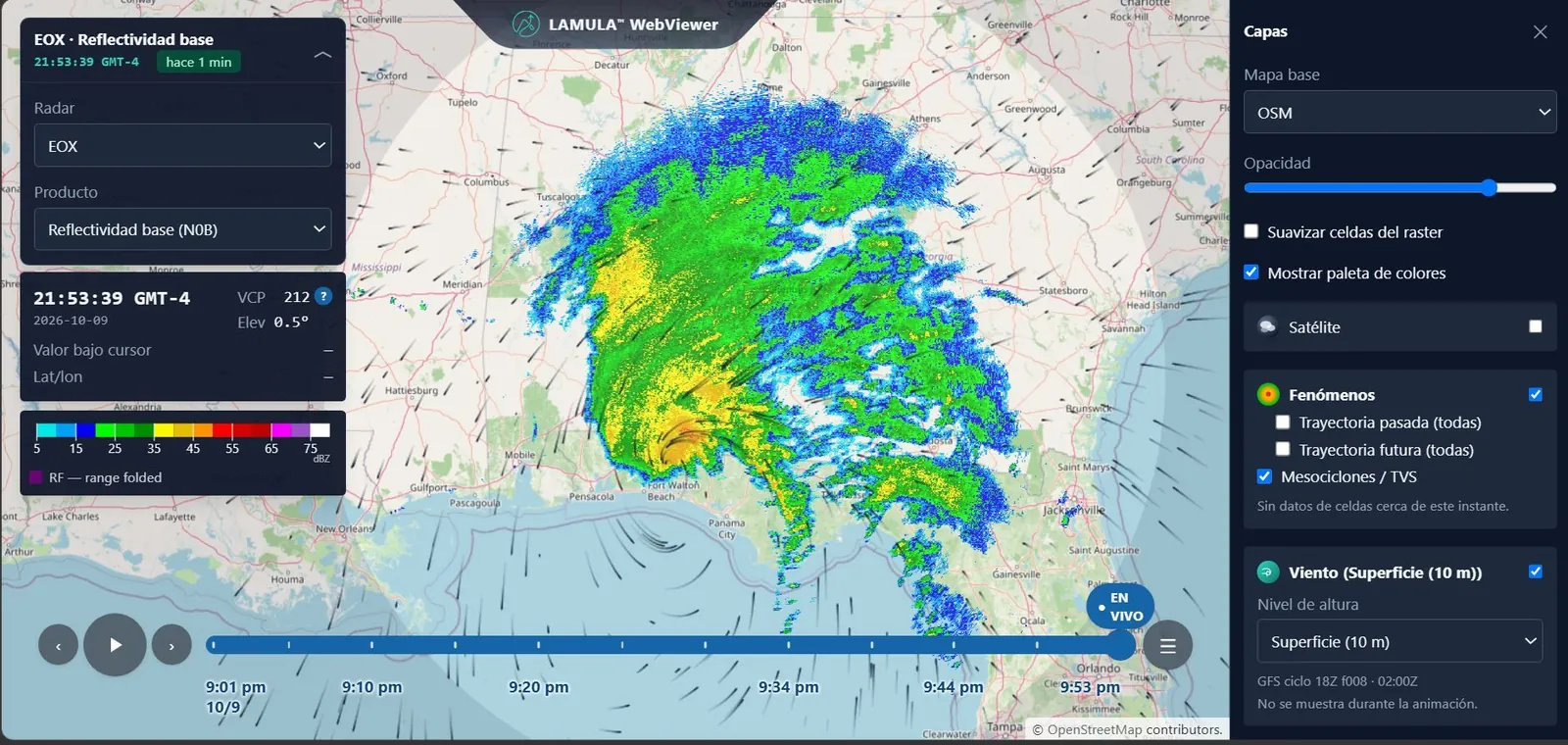
LAMULA WebViewer showing base reflectivity from the KEOX radar: a large precipitation system over the Gulf coast of Alabama, Georgia and Florida, with a dBZ colour scale and surface wind barbs.
KEOX, base reflectivity (N0B), VCP 212, elevation 0.5° — 9 October 2026, 21:53 GMT−4. NEXRAD Level III decoded, regridded and rendered by the chain described below. Basemap © OpenStreetMap contributors.

00

The system

A commercial weather radar's processing chain, rebuilt end to end with no dependency on the original vendor. Select a stage.

The system

Status and provenance

LAMULA is open source and, today, a proof of concept — not a system in operation. What makes the chain above credible is not this repository but what it descends from: Vesta, the processing suite we built at the Cuban meteorological service between 2012 and 2014, which has been running that country's radar network ever since — a Gematronik radar among them.

Credit where it is due. The chain is my work, written largely with AI assistance, on top of a body of work that belongs to the team: parts of it start from Vesta code that was not all mine, and the only way this stops being a proof of concept and becomes a product is the experience of that whole team, not mine alone.

01

About

I trained as an electrical engineer at the Universidad de Camagüey (BSc summa cum laude, 2008; MSc in industrial electrical systems, 2009) and I have been teaching there since the year I graduated — control engineering, industrial automation and PLCs, electric drives, and two electives I wrote myself, FPGA design and Arduino. I am a Profesor Titular, the highest academic rank in Cuban higher education.

Weather radar came next. From 2012 to 2014 I wrote software at the Camagüey Meteorological Centre: the parser for the raw radar data, the Level III processing and database loading, the ingest into ORPG, the first web viewer. That software still runs the Cuban radar network today.

The doctorate ran in parallel. Invited to INAOE in late 2013 for my FPGA experience, I spent four years on reduct computation — an NP-hard combinatorial problem — and attacked it from both ends at once: two new algorithms, GCreduct and MinReduct, and hardware architectures to accelerate them. One investigation, defended twice: UCLV in Cuba (2019) and BUAP in Mexico (2022).

Since 2022 I have led software teams for clients in the United States, and since 2023 I have been a founder of LADETEC, with the radar specialists I worked beside at the meteorological centre. The thread has not changed: the algorithm and the machine it runs on, designed together.

02

Research

Doctoral work on algorithms for an NP-hard combinatorial problem, and the hardware to run them faster — alongside earlier published work on weather-radar data processing and on engineering teaching.

Doctoral thesis

Development of fast algorithms for reduct computation

Benemérita Universidad Autónoma de Puebla, 2022. Language and Knowledge Engineering. Contributes two new algorithms — GCreduct (all reducts) and MinReduct (all shortest reducts) — alongside a study of hardware architectures for accelerating the computation.

BUAP institutional repository →

Publications

Reduct computation

  • 2021

    A Comparative Study of Two Algorithms for Computing the Shortest Reducts: MiLIT and MinReduct

    Conference

    Vladímir Rodríguez-Diez, José Fco. Martínez-Trinidad, J. Ariel Carrasco-Ochoa, Manuel S. Lazo-Cortés, J. Arturo Olvera-López

    Mexican Conference on Pattern Recognition (MCPR), LNCS pp. 57–67

    Head-to-head evaluation of the two fastest published algorithms for computing all the shortest reducts, identifying which decision-system characteristics favour each.

    DOI

  • 2020

    MinReduct: A new algorithm for computing the shortest reducts

    Journal

    Vladímir Rodríguez-Diez, José Fco. Martínez-Trinidad, J. Ariel Carrasco-Ochoa, Manuel S. Lazo-Cortés, J. Arturo Olvera-López

    Pattern Recognition Letters vol. 138, pp. 177–184

    Computes all the shortest reducts of a decision system using binary cumulative operations over a pairwise comparison matrix, with a fast candidate evaluation that avoids the costly operations most prior algorithms rely on.

    DOI

  • 2018

    A new algorithm for reduct computation based on gap elimination and attribute contribution

    Journal

    Vladímir Rodríguez-Diez, José Fco. Martínez-Trinidad, Jesús A. Carrasco-Ochoa, Manuel S. Lazo-Cortés

    Information Sciences vol. 435, pp. 111–123

    GCreduct: computes all reducts of a decision system using the pruning properties of gap elimination and attribute contribution, with simpler candidate-evaluation operations to cut runtime.

    DOI

  • 2018

    The Impact of Basic Matrix Dimension on the Performance of Algorithms for Computing Typical Testors

    Conference

    Vladímir Rodríguez-Diez, José Fco. Martínez-Trinidad, Jesús Ariel Carrasco-Ochoa, Manuel S. Lazo-Cortés

    Mexican Conference on Pattern Recognition (MCPR), LNCS pp. 41–50

    Experimental study of how the dimensions of the basic matrix affect algorithm runtime — evidence for choosing the right algorithm for a given dataset rather than assuming one dominates.

    DOI

  • 2017

    Fast-BR vs. Fast-CT_EXT: An Empirical Performance Study

    Conference

    Vladímir Rodríguez-Diez, José Fco. Martínez-Trinidad, J. Ariel Carrasco-Ochoa, Manuel S. Lazo-Cortés

    Mexican Conference on Pattern Recognition (MCPR), LNCS pp. 127–136

    Empirical comparison of the two fastest state-of-the-art algorithms for computing typical testors, over synthetic basic matrices with controlled characteristics and over standard UCI datasets.

    DOI

  • 2015

    A fast hardware software platform for computing irreducible testors

    Journal

    Vladímir Rodríguez-Diez, José Francisco Martínez-Trinidad, Jesús Ariel Carrasco-Ochoa, Manuel S. Lazo-Cortés, Claudia Feregrino-Uribe, René Cumplido

    Expert Systems with Applications vol. 42, pp. 9612–9619

    A hardware/software co-designed FPGA platform for computing irreducible testors, following a pruning strategy that cuts the number of candidates evaluated — the algorithm and the silicon designed together.

    DOI

  • 2014

    A hardware architecture for filtering irreducible testors

    Conference

    Vladímir Rodríguez-Diez, José Fco. Martínez-Trinidad, J. Ariel Carrasco-Ochoa, Manuel S. Lazo-Cortés, René Cumplido, Claudia Feregrino-Uribe

    International Conference on ReConFigurable Computing and FPGAs (ReConFig) pp. 1–4

    An FPGA architecture that filters irreducible testors in hardware, removing the step that dominated runtime in software implementations. The design that led to the hardware/software platform published the following year.

    DOI

Radar data processing

  • 2012

    Simulador de radar meteorológico basado en modelo de reflectividades en el espacio

    Journal

    Vladímir Rodríguez Diez, Orlando L. Rodríguez González, Milagros Diez Rodríguez

    Ingeniería Energética vol. XXXIII, n.º 2, pp. 103–112

    A weather-radar simulator driven by a spatial reflectivity distribution, used to study how the scan pattern and the acquisition and processing scheme distort the perception of a meteorological target. The question that the whole LAMULA chain is a working answer to, asked fourteen years earlier.

    PDF

  • 2010

    Data processing in weather radars revisited

    Conference

    Vladímir Rodríguez Diez, Orlando L. Rodríguez González

    ERAD — Sixth European Conference on Radar in Meteorology and Hydrology Sibiu, Romania

    A review of the weather-radar data processing chain presented at ERAD — the first published piece of the radar work, two years before the Camagüey Meteorological Centre.

    PDF

Engineering education

  • 2015

    Instrumento virtual con acceso local y remoto para prácticas de Ingeniería del Control

    Journal

    Orlando Regalón Anias, Vladímir Rodríguez Diez, Milagros Diez Rodríguez, Raúl Báez Prieto, Leisis López Rodríguez, Francisco Pacheco Ballagas

    RIELAC — Revista de Ingeniería Electrónica, Automática y Comunicaciones vol. XXXVI, n.º 3, pp. 69–79

    A virtual instrument reachable both from the lab bench and over the network, so a control-engineering practical does not depend on a student being physically in front of the rig. The same problem ModbusLab solves today.

    PDF

  • 2015

    Automatización integral del proceso de secado de bioproductos

    Journal

    Orlando Regalón Anias, Josué García Parrado, Danny Echevarría Báez, Francisco Herrera Fernández, Yunier Paneque Díaz, Santiago Bardanca Consuegra, Jesús Zamora Sánchez, Vladímir Rodríguez Diez, Leisis López Rodríguez

    RIELAC — Revista de Ingeniería Electrónica, Automática y Comunicaciones vol. XXXVI, n.º 2, pp. 1–14

    Full automation of a bioproduct drying process — industrial automation applied to a real plant, the field the Industrial Automation course teaches.

    PDF

  • 2012

    Aplicación de algoritmos de control clásico, adaptable y robusto a sistemas dinámicos de parámetros variables

    Journal

    Orlando Regalón Anias, Vladímir Rodríguez Diez, Milagros Diez Rodríguez, Raúl Báez Prieto

    Ingeniería Energética vol. XXXIII, n.º 3, pp. 184–195

    Classical, adaptive and robust control compared on first-order systems whose parameters drift over time — the trade-off that decides which controller a plant actually gets.

    PDF

  • 2009

    Software para el procesamiento de los ensayos de la máquina sincrónica

    Journal

    Orlando L. Rodríguez González, Vladímir Rodríguez Diez

    Ingeniería Energética vol. XXX, n.º 1, pp. 30–36

    Software for processing synchronous-machine test data, written the year I graduated. The first thing I published, and already the same pattern: an instrument produces data, and the data needs a program.

    PDF

Full list on Google Scholar →

Advanced training

  • 2019 Advanced Workshop on Modern FPGA-Based Technology for Scientific Computing Trieste, Italy
  • 2012 Latin-American Advanced Course on FPGA Design for Scientific Instrumentation Havana, Cuba
  • 2008 Second Workshop on Distributed Laboratory Instrumentation Systems Valdivia, Chile

03

Projects

Fewer, deeper. Each one states what it does not cover.

2021—

LAMULA — vendor-independent weather radar chain

Proof of concept

The full processing chain of a commercial weather radar, rebuilt from the FPGA digital receiver to the WebGL product viewer.

The problem. A weather radar whose control and processing software is a closed vendor suite is a radar you cannot maintain, extend or repair on your own terms. Spare parts and licences become a single point of failure for a national observation asset.

The constraint that is not negotiable. The meteorological data must stay standard. Rebuilding the chain is worthless if the output stops being readable by the tools and archives the field already uses.

The decision. Emulate the interface instead of licensing it. The control processor archives volume observations as NEXRAD Level-II and presents itself to ORPG as a WSR-88D RDA by implementing ICD 2620002 in full. The standard becomes the seam: everything behind it is ours, everything in front of it is unchanged.

Where it stands. Open source, and today a proof of concept — not a system in operation. It descends from Vesta, the processing suite the team built at the Cuban meteorological service, which has run that network since 2014, a Gematronik radar among them. Parts of this chain start from Vesta code that was not all mine, and finishing it needs the whole team, not just me.

What the design bought. A hardware abstraction layer with two interchangeable adapters — the real plant over Modbus TCP / Profibus, and a faithful simulator — so control logic is developed and tested without occupying the radar. Hard real-time stays in the FPGA and DSP; the orchestration layer is soft real-time Python and does not pretend otherwise.

  • FPGA / Xilinx
  • C
  • Python
  • Vue 3
  • Nuxt 3
  • OpenLayers WebGL
  • Modbus TCP
  • Profibus
  • Docker Swarm
  • PostgreSQL
2026

Replacing a 20-year-old commission engine

In production

A money-critical MLM commission engine, replaced on a cold cutover with no parallel run — and the four months of reconciliation that followed.

The problem. Twenty years of commission rules living in accumulated SQL, with nested conditionals whose execution path depended on the year a plan had been configured. The source was readable; the intent was not. The person who designed it was unavailable.

The constraint that was not negotiable. A cold cutover. The old engine was switched off at 23:59 on the 20th of the month and the new one went live the same night, with no parallel run — so the first two biweekly periods were part old engine, which could no longer be queried, and part new engine, which did not yet encode every rule.

What did not work. Reading the old SQL to recover the rules. We stopped writing code and sat with the client's finance department to define the terms instead: what a generation is, what makes a director active, what happens when someone changes level mid-month. The hardest case was multi-level commissions paid to directors over successive generations below them, on a hierarchy that changes over time — a slowly changing dimension, with almost no clean history to validate against.

The outcome, stated honestly. About four months of cycles with errors, reconciled with finance, each discrepancy traced to a specific plan rule rather than written off as a system fault. Residual error at the end: on the order of $100 in total, across payments summing to hundreds of thousands of dollars distributed among thousands of consultants. Written four-handed with Alejandro Cespón.

The number worth quoting here is not the one that sounds good. Four months of errors is the honest headline; the ~$100 residual is what the four months bought.

  • Python
  • SQL
  • Recursive CTEs
  • BigCommerce
  • Kill Bill
2026—

Radar Siting Toolkit

Early scaffolding

Open-source QGIS plugin answering where weather radars should be sited, and what each configuration would actually see.

The problem. Siting a radar network is an investment decision made by a government or a donor. It needs reproducible geometric evidence, not a pretty coverage picture.

The decision that matters. For each azimuth the terrain is sampled along the ray at native DEM resolution, accumulating the maximum horizon angle seen up to each range, corrected for earth curvature by an effective-radius factor. Minimum clear elevation and minimum visible height fall out directly — a single O(N) pass per ray, with no discrete elevation-angle loop.

A detail that is easy to get wrong. Partial beam blockage is published as the range-cumulative maximum, never as raw per-bin PBB. Publishing per-bin values produces wrong maps across the entire sector behind an obstacle.

A dependency refused on purpose. Implemented in plain numpy. wradlib would pull in scipy, matplotlib, xarray and xradar and recommends a conda install — which cannot be installed from the QGIS Plugin Manager, where the users actually are. wradlib is used offline, as a validation reference only.

This toolkit covers roughly 15% of a full siting study. Saying so is the point: the number that is defensible is worth more than the number that is impressive.

Explicitly out of scope

  • Rain attenuation and frequency-band selection
  • Real anomalous propagation — only the effective earth-radius factor is parameterised
  • Sea clutter, ground clutter, RF interference, spectrum compatibility
  • Quantitative precipitation estimation and nowcasting
  • Tower structure, radome, wind load, electrical resilience
  • Cost, lifecycle and staffing
  • Python
  • numpy
  • QGIS
  • GDAL
  • Jupyter
2012 · 2026

ModbusLab — virtual industrial automation laboratory

In production

A Modbus teaching lab built as a PyQt desktop application in 2012, abandoned when the hardware it still needed became unavailable, and rebuilt in 2026 with no hardware at all.

The problem. Industrial automation is taught on equipment that is expensive, scarce, and sitting in one room. A student with an hour of lab time a week does not get to make the mistakes that teach the subject.

The first answer, in 2012. A PyQt desktop application driving the lab's Modbus devices. It ran for two or three course cycles and then stopped being used — because it had not actually removed the constraint. The software was on the student's machine, but the PLC and the power analyser were still in the laboratory, and when that hardware stopped being available the tool went with it.

The second answer, fourteen years later. The same idea rebuilt with the devices themselves simulated: a virtual Master-K120S PLC and a virtual WM14 power analyser served over the web, speaking Modbus. Nothing physical is required, so the laboratory is wherever the student is. My students are using it now.

What it demonstrates. Not persistence — diagnosis. The 2012 version failed for a reason I could name, and the rebuild is aimed at that reason rather than at the technology that had moved on in the meantime.

  • SvelteKit
  • TypeScript
  • Cloudflare Workers
  • Modbus RTU/TCP
  • Python
  • PyQt
2015—2022

Reduct computation: from the algorithm to the FPGA

Archived

Doctoral work on an NP-hard combinatorial problem, attacked simultaneously in algorithm design and in hardware.

The problem. Computing all reducts of a decision system — the minimal attribute subsets that preserve its discernibility — is NP-hard. The naive approach enumerates the power set, and the cost is not something you optimise your way out of with better code.

Two fronts at once. On the algorithmic side, GCreduct prunes the search space using gap elimination and attribute contribution; MinReduct computes all the shortest reducts without enumerating the rest. On the hardware side, a co-designed FPGA platform accelerates the computation of irreducible testors.

Why it still matters here. It is the same instinct that produced everything else on this page: when a computation is expensive, the answer is rarely a bigger machine. It is a better algorithm, the right place to run it, and the willingness to design both.

  • FPGA
  • VHDL
  • C
  • Rough set theory

04

Experience

Teaching since 2008; engineering and software throughout.

Roles

  • 2023 – present

    Founder and software lead

    LADETEC · Cuba

    • Founded with the weather-radar specialists I had worked alongside at the Camagüey Meteorological Centre — the same people, now a private company.
    • I set technical direction and choose the stack; these days I write far less code than I decide what gets written.
    • Industrial automation built on ESP32 for Cuban industry: water pumping, sterilisation, weighing with HX711 load cells, power metering.
  • 2022 – present

    Development lead

    Nitza Develop · Remote · United States clients

    • Led the team behind PzHub, the back-office platform PinkZebra runs its daily operations on, and a subscription system for its store built on Kill Bill.
    • Replaced PinkZebra's 20-year-old commission engine on a cold cutover, down to a residual error of around $100 across payments in the hundreds of thousands — written four-handed with Alejandro Cespón.
    • Built TowitLinks, a VoIP platform from scratch with web, Android and iOS clients; and a custom ERP for a hotshot-trailer rental and repair business, which grew from a solo job into my first time leading a team.
    • A GPS tracker for trailers, designed remotely: I did the firmware and backend, the client did the soldering and 3D printing.
    • Teams of up to 5 part-time developers per project; at the peak, across PinkZebra and Towit Houston, around 10 developers under my supervision.
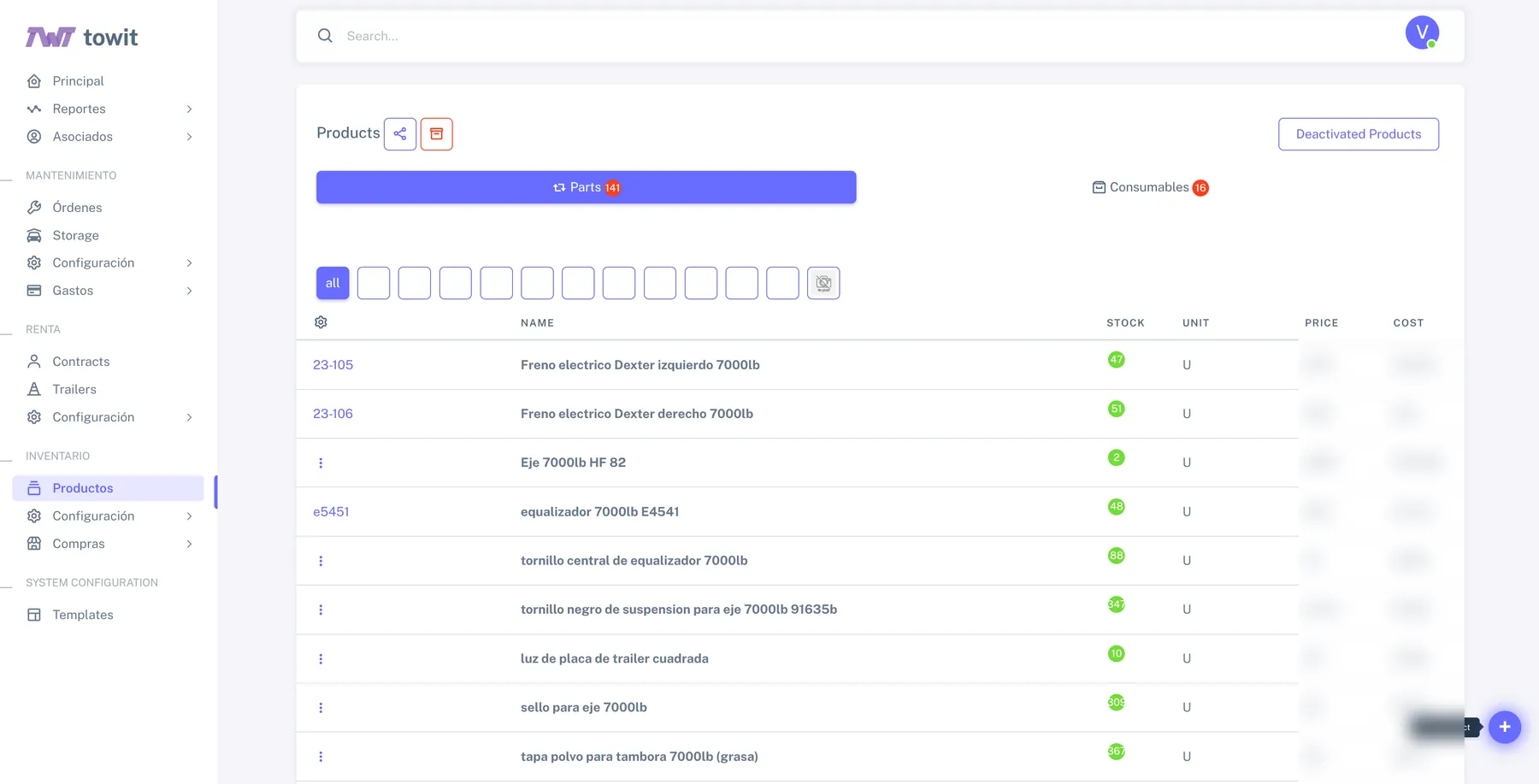
    • Inventory screen of the custom ERP built for Towit Houston: a parts list with stock levels, beside navigation for work orders, storage, rental contracts, trailers and purchasing.
      The trailer ERP, inventory module. Prices and supplier costs are blurred — they are the client’s margin, not mine to publish.
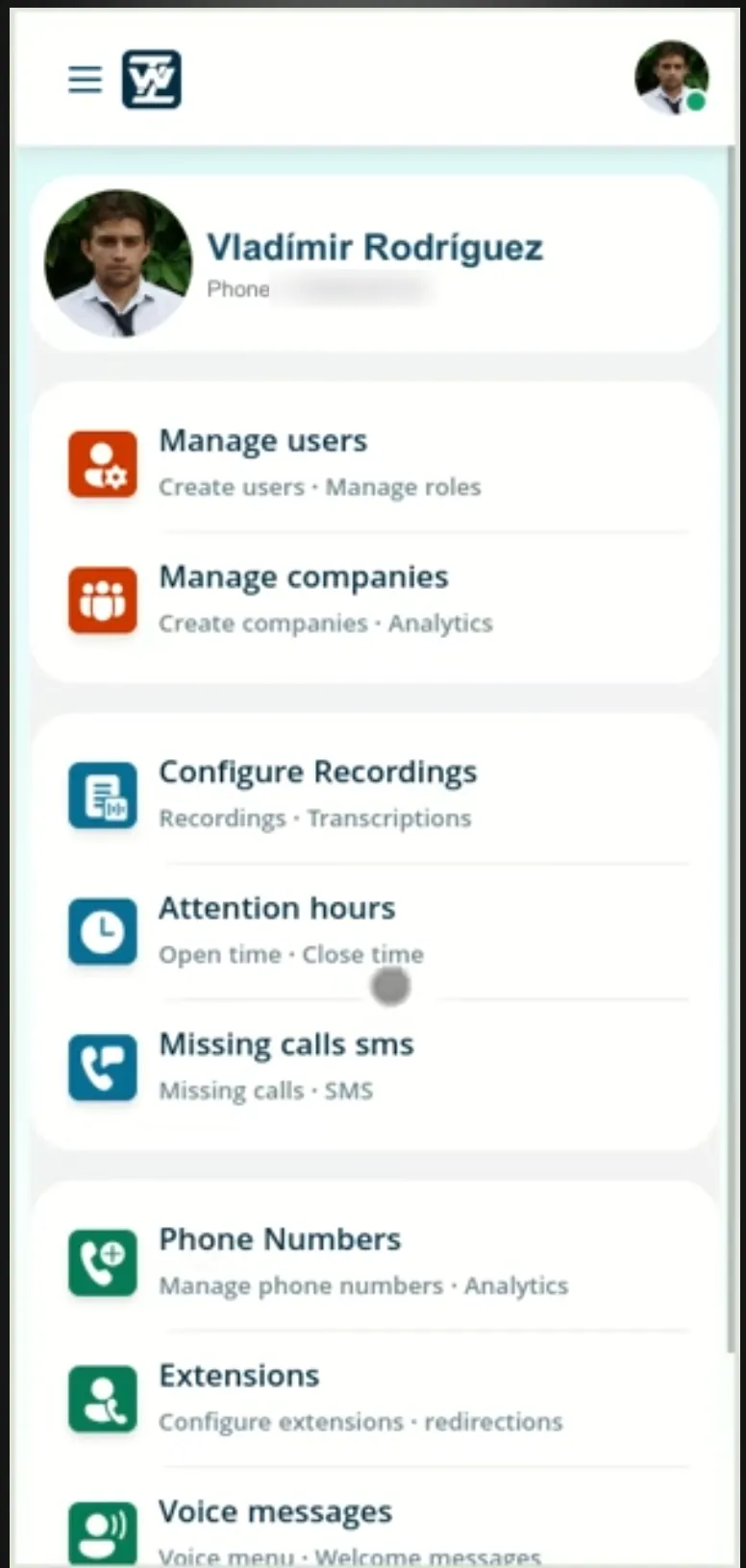
    • TowitLinks administration menu on a phone: manage users, manage companies, configure recordings and transcriptions, attention hours, missed-call SMS, phone numbers, extensions and voice messages.
      TowitLinks, administration on the mobile client. The number on my own account is blurred.
  • 2012 – 2014

    Software developer

    Centro Meteorológico de Camagüey · Instituto de Meteorología de Cuba · Camagüey, Cuba

    • ObsParser: a Python library for reading the raw data of the Cuban weather radars.
    • Vesta PostGIS: processing of ORPG Level III products into a database and an FTP raster feed. RdaBackend: ingest from the Cuban radars into ORPG.
    • Vesta WebView: web visualisation of radar data with GWT and OpenLayers — the direct ancestor of what I build today.
    • Clear-air observation processing to generate ground-clutter templates; TITAN customised into the national processing suite; GEMPAK configured to build mosaics from ORPG products.
    • Support and operations for all of it throughout. It is still running in the Cuban radar network today.
  • 2008 – present

    Full professor of Electrical Engineering

    Universidad de Camagüey · Camagüey, Cuba · Faculty of Electromechanics

    • Profesor Titular — the highest academic rank in Cuban higher education.
    • Six courses taught across the degree, from classical control to FPGA design; four core, two electives I proposed and wrote myself.
    • Currently: Automated Electric Drives one semester, Industrial Automation the next, around 20 students per group.
    • Roughly 300 students since 2008 — about 20 a year, with a thinner stretch from 2015 to 2019 while the doctorate was the priority.

Teaching

  • Control Engineering 6th semester
  • Industrial Automation and PLCs 7th semester
  • Automated Electric Drives 8th semester
  • Simulation
  • Sequential System Design (FPGA, VHDL) elective
  • Arduino for Electrical Engineers elective

Course in depth

2017 – 2020

Introduction to Arduino for Electrical Engineers

Universidad de Camagüey · Electrical Engineering Dept., Faculty of Electromechanics

An elective I designed and taught: typical problems of the degree solved with an Arduino program instead of a relay panel or a PLC. 12 h of lectures, 12 h of lab, 8 h of assessment, and a final project each student had to build and demonstrate.

  • Six lectures written from scratch: introduction, data types, decision making, loops, functions, scope.
  • 23 students in the 2019 cohort — the one year the whole class took it rather than a self-selected group — each delivering a working final project: an injector test bench, a spot welder, an electronic lock, a wattmeter, a water-pump controller, a proximity alarm.
  • Also taught as a three-day open workshop in Camagüey, 12–14 October 2018.

Education

  • January 2019 – December 2022

    PhD in Computer Sciences

    Benemérita Universidad Autónoma de Puebla · Puebla, Mexico

    Language and Knowledge Engineering

    Thesis: Development of fast algorithms for reduct computation. Coursework completed remotely while teaching in Cuba.

  • Defended December 2019

    Doctor of Technical Sciences

    Universidad Central "Marta Abreu" de Las Villas · Santa Clara, Cuba

    Same body of research, defended in Spanish as Desarrollo de estrategias para el cálculo de reductos en sistemas de decisión. Advisor: Dra. Yailé Caballero Mota. Two doctoral degrees, one investigation — the Cuban route ran in parallel with the Mexican one.

  • 2014 – 2018

    Doctoral research

    Instituto Nacional de Astrofísica, Óptica y Electrónica (INAOE) · Tonantzintla, Puebla, Mexico

    Computer Science Department

    CONACYT fellowship 399547. Where the work behind all three journal papers was done — I arrived in late 2013 on a research visit, invited for prior FPGA experience, which became the 2015 Expert Systems with Applications platform.

  • September 2008 – April 2009

    MSc in Electrical Engineering

    Universidad de Camagüey · Camagüey, Cuba

    Industrial Electrical Systems

  • September 2003 – July 2008

    BSc in Electrical Engineering

    Universidad de Camagüey · Camagüey, Cuba

    Graduated summa cum laude.

05

Contact

Open to engineering roles, research collaboration and consulting work. Spanish or English.

Email

vladimir@ladetec.com

Mexico City, Mexico